Your First 90 Days
What nobody tells you before your first professional shift
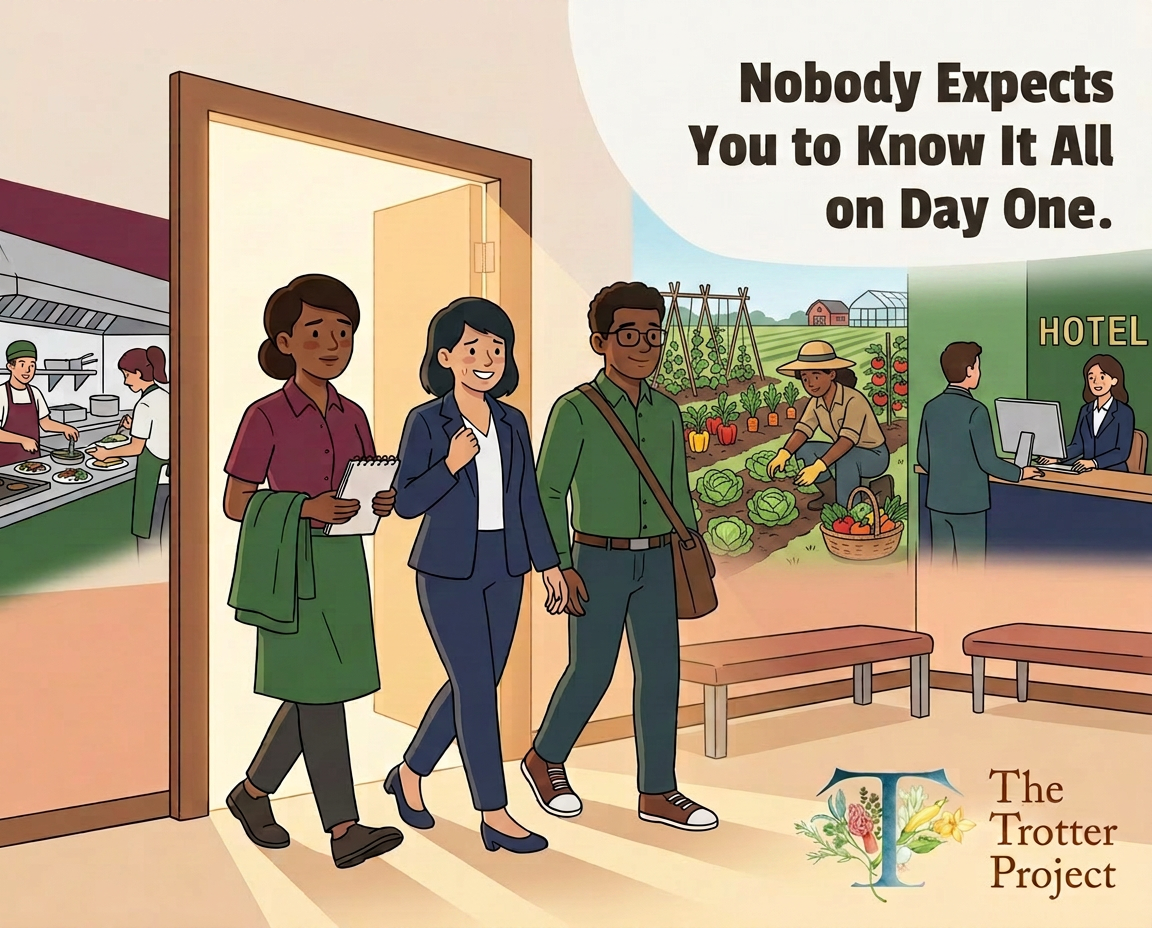
You remember every detail of the drive there. The uniform is still stiff, the name tag slightly crooked, your stomach doing something between excitement and dread. Then you walk in, and it hits you: Everyone already knows where things are, what things are called, and who's who. You don't. Welcome to day one.
Nobody hands you a map for this part. School teaches you the craft, the knife skills, the front-desk software, the lab protocols, but not how to walk into a room full of strangers who already work like a team and become one of them. That's what the first 90 days are really about, and it's the same challenge whether you're standing at a cutting board, behind a front desk, or at a lab bench: You're learning the job and the room at the same time.
Learn the Map Before You Learn the Job
Every workplace has a hierarchy, and most of it is unspoken. Figuring out who does what, and who to go to for what, will save you more stress than any technical skill in your first few weeks.
In a kitchen, you'll hear it called the brigade system, and it still shapes most professional kitchens today:
Executive Chef: sets the vision, menu, and standards for the whole kitchen.
Sous Chef: runs day-to-day operations and is often your most direct line of communication.
Station or Line Cooks: own a specific station (grill, sauté, pastry) and are your closest peers.
Commis or Prep Cooks: support the line and are frequently where new hires start.
In a hotel or hospitality setting, the structure runs both vertically and across departments:
General Manager: oversees the entire property and sets overall standards.
Department Heads: (Front Office, Housekeeping, F&B, Events) manage their own teams and report to the GM.
Shift Supervisors or Leads: run the floor day-to-day and are usually your first point of contact.
Front-Line Associates: handle direct guest interaction — this is where most new hires begin.
If your path runs through food science or agriculture, the hierarchy looks a little different but works the same way. It's still a team you're learning to read:
Plant or Production Manager: oversees the entire operation, from safety to output.
Quality Assurance Lead: sets and enforces standards for every batch that goes out the door.
Line or Shift Supervisors: manage day-to-day production and are your closest point of contact.
Technicians and Production Staff: run the equipment and processes; often where new hires begin, and a track that feeds directly into the same hospitality and food-industry pipeline as culinary and hotel roles.
You don't need to memorize an org chart on day one. Just notice: who gives instructions, who answers questions, and who you'd go to if something went wrong. That's your map.
Asking Questions Without Looking Incompetent
Here's the truth: Everyone can tell who the new person is anyway. Trying to hide it by staying quiet doesn't make you look more capable. It just means you make avoidable mistakes. The goal isn't to ask fewer questions. It's to ask better ones.
Ask specific questions, not vague ones: "Should the pan be this hot?" lands better than "Am I doing this right?" Specific questions show you're already thinking like part of the team.
Watch one full cycle before you ask: If you can, observe a task once before jumping in. Half your questions will answer themselves.
Write it down so you only ask once: Keep a small notebook or notes app open. Repeating a question you were already told is what actually reads as careless.
Time it: Save non-urgent questions for a natural lull rather than the middle of a rush. Urgent, safety-related questions are always the exception. Ask those immediately, every time.
Building Trust as the Newest Person in the Room
Trust in a new role isn't won with a single big moment. It's built in dozens of small ones, most of which have nothing to do with your technical skill.
Show up early and stay steady: Arriving a few minutes ahead and staying calm during a rush says more than any resume line.
Do the unglamorous tasks well: Every role has them: the side work, the closing checklist, the cleanup. How you handle the small stuff is what people notice first.
Follow through on every small ask: If you say you'll do something, do it, and let someone know when it's done. Reliability compounds fast.
Let your work speak before your opinions do: You'll have ideas early on, and some of them may even be good ones. Earn a little runway first. People are far more open to input from someone whose work they already trust.
You're Not Supposed to Have It Figured Out Yet
Ninety days isn't a deadline for mastery. It's roughly how long it takes to stop feeling like a stranger in the room. Give yourself that runway. Every chef, general manager, and production lead started exactly where you are now: unsure of the map, asking questions, earning trust one shift at a time.
That's the whole idea behind The Trotter Project's mentorship and career resources. You shouldn't have to figure this part out alone. Explore more career guidance and connect with mentors who've been exactly where you are at thetrotterproject.org.