
Not All Credentials Are Created Equal
The Food Industry Certifications That Actually Matter and When to Pursue Them
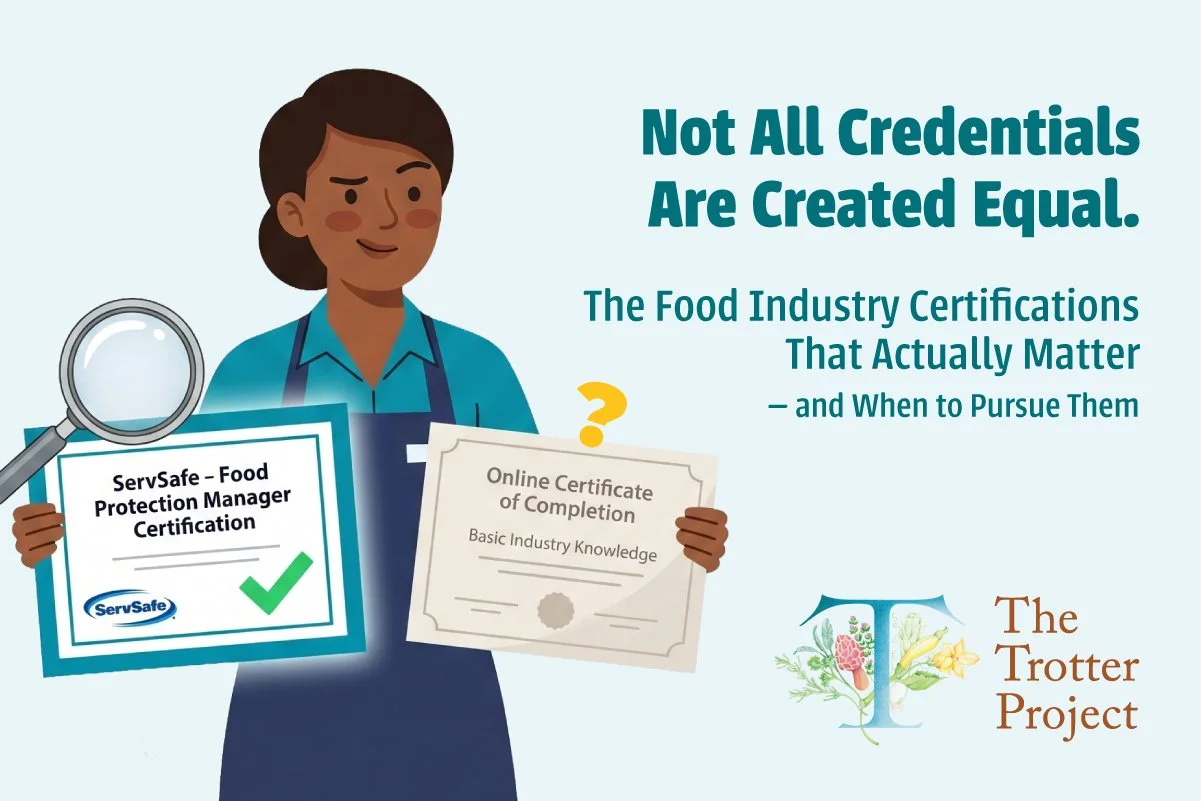
Here's a scenario that plays out more than it should: A student spends several hundred dollars and weeks of prep time on a certification, puts it on their résumé, and then discovers that the employers they're interviewing with have never heard of it — or don't care.
Credentials can open doors. The wrong ones at the wrong time can drain your budget and clutter your résumé with noise that doesn't move the needle.
This guide is about cutting through that confusion. Whether you're studying culinary arts, hospitality management, or food science and agriculture, here's what actually matters to employers and when it makes sense to pursue it.
First, a Useful Distinction
Before diving in, it helps to understand the difference between a certificate and a certification.
A certificate is awarded by a school or training program after you complete a course. It shows you attended and learned. A certification is granted by a professional organization after you pass an exam, demonstrate experience, or meet specific criteria. It signals a validated, industry-recognized level of competency.
Both have value. But they're not the same thing, and employers notice the difference. A certification from the American Culinary Federation carries more industry weight than a generic online food safety certificate. Knowing which is which helps you spend your time and money wisely.
Culinary Arts & Baking/Pastry
ServSafe Food Handler / Food Manager Certification
Issuer: National Restaurant Association Educational Foundation
This is the non-negotiable baseline for anyone working in food service. ServSafe is required or strongly preferred by the vast majority of foodservice employers in the U.S. The Food Handler certificate is entry-level; the Food Manager certification is the one employers take more seriously and is often required for supervisory roles. If you only pursue one credential early in your culinary career, make it ServSafe Manager.
When to pursue it: As early as possible: Ideally before your first industry job or internship.
ACF Certified Culinarian (CC) / Certified Fundamental Cook (CFC)
Issuer: American Culinary Federation
The ACF offers a tiered certification framework endorsed by the U.S. Department of Labor. The Certified Fundamental Cook (CFC) is designed for students and early-career professionals as an accessible entry point. The Certified Culinarian (CC) is the next step and carries meaningful weight with restaurant, hotel, and institutional employers. Higher tiers, Certified Sous Chef (CSC), Certified Executive Chef (CEC), follow with experience.
When to pursue it: CFC while still in school; CC after graduation with some kitchen experience under your belt.
WSET Level 2 / Court of Master Sommeliers Introductory Certification
Issuer: Wine & Spirit Education Trust / Court of Master Sommeliers
For students interested in beverage programs, fine dining, or management tracks that include wine and spirits, WSET and CMS are the two most respected credential pathways. WSET focuses more on theory and production knowledge; CMS is tailored to floor service and hospitality settings. Either one signals to employers that you take beverage seriously, and in fine dining, that stands out.
When to pursue it: After gaining some professional kitchen or service experience; most valuable once you're targeting roles in fine dining or beverage management.
Hospitality Management
ServSafe Food Manager Certification
Issuer: National Restaurant Association Educational Foundation
Yes, this one appears in both sections because it's relevant to hospitality managers too. Any manager overseeing food service operations, even outside a kitchen context, benefits from holding this credential. Some states require it for managerial roles.
When to pursue it: Early: Before or during your first management-track internship.
Certified Hospitality & Tourism Management Professional (CHTMP)
Issuer: American Hotel & Lodging Educational Institute (AHLEI)
AHLEI is one of the most established credentialing bodies in the hospitality industry. Their suite of certifications, including the CHTMP and the Certified Hospitality Supervisor (CHS), are recognized by hotel chains, resorts, and large hospitality operators worldwide. If you're targeting hotel or resort management, AHLEI credentials signal that you speak the industry's language.
When to pursue it: CHS during school or early career; CHTMP once you have a year or more of hospitality experience.
Guest Service Gold Certification
Issuer: American Hotel & Lodging Educational Institute
A lighter-weight but genuinely employer-valued credential for students entering guest-facing roles. It covers the interpersonal and service standards that hospitality employers consistently say new hires lack. Quick to obtain and inexpensive, a smart early move for anyone heading into hotel, resort, or events work.
When to pursue it: Before your first guest-facing internship or job.
Certified Meeting Professional (CMP)
Issuer: Events Industry Council
For students interested in catering, event planning, or conference and meetings management, the CMP is the gold standard. It requires work experience to qualify, so it's not a student credential, but knowing it exists and working toward eligibility is a smart long-game move.
When to pursue it: After 2–3 years of professional event or hospitality experience.
Food Science & Agriculture
ServSafe Food Manager Certification
Issuer: National Restaurant Association Educational Foundation
It shows up a third time for good reason. Even in food science and agricultural careers, employers in processing, manufacturing, and quality assurance environments expect food safety literacy. ServSafe is the fastest and most affordable way to demonstrate it.
When to pursue it: Early: Before entering any production or processing internship.
HACCP Training Certificate
Issuer: International HACCP Alliance (multiple accredited providers)
Hazard Analysis and Critical Control Points (HACCP) is a globally recognized food safety framework required or expected across food production, processing, and manufacturing. An HACCP training certificate from an International HACCP Alliance-accredited provider is a meaningful signal to employers in food science, supply chain, and quality control roles. It's not a certification in the professional-organization sense, but it carries real credibility in the industry.
When to pursue it: During your junior or senior year, or before entering a food production or quality-focused internship.
PCQI — Preventive Controls Qualified Individual
Issuer: Food Safety Preventive Controls Alliance (FSPCA) / FDA-recognized curriculum
Under the FDA's Food Safety Modernization Act (FSMA), food facilities that manufacture or process food for the U.S. market are required to have a PCQI on staff. This designation, earned through an FSPCA-approved training course, is increasingly valued by employers in food manufacturing, quality assurance, and regulatory affairs. It signals that you understand the compliance side of food safety, not just the operational side.
When to pursue it: Late in your degree program or in your first professional role in food science or manufacturing. Often employer-sponsored once you're working in the field.
SCA Coffee Skills Program
Issuer: Specialty Coffee Association
For students with an interest in specialty beverage, food entrepreneurship, or agricultural supply chains in the coffee sector, SCA certifications are internationally recognized and actively sought by specialty coffee employers. The program is modular. You can start with Barista Skills or Introduction to Coffee and build from there.
When to pursue it: Whenever your career interest points in this direction; no experience required for foundation-level modules.
A Few Things Worth Remembering
Employer recognition matters more than credential prestige. Before pursuing any certification, ask: Do the employers I want to work for actually value this? A quick LinkedIn search or informational conversation with a professional in your target role can save you time and money.
Some credentials require experience you don't have yet and that's fine. The CMP, the higher ACF tiers, and the PCQI all make more sense later in your career. Knowing they exist and planning toward them is just as useful as rushing to earn them now.
Your degree is still the foundation. Certifications supplement a strong educational background, they don't replace it. The students who get the most out of credentials are the ones who pair them with relevant internships, real-world experience, and a clear sense of where they're headed.
Cost is a real factor. ServSafe is inexpensive. PCQI training can run several hundred dollars. WSET Level 3 costs more. Some employers reimburse certification costs for employees, worth asking about before you pay out of pocket.
The credential landscape in food and hospitality is wide, and it grows every year. But the core principle stays the same: pursue what employers in your target field actually recognize, at the stage of your career where it will make the most difference.
If you're not sure where to start, start with ServSafe. Everything else builds from there. In the meantime, download our credential guide.